
Hair Transplantation: A Complete Guide to Methods, Recovery, Risks, and Natural Results
Hair transplantation is a surgical hair-restoration procedure in which hair follicles are moved from an area with stronger hair growth to an area affected by thinning or baldness.
The donor area is usually located at the back or sides of the scalp, where hair follicles may be more resistant to the processes involved in common pattern hair loss.
Hair transplantation can help restore:
- Receding hairlines
- Frontal thinning
- Crown thinning
- Localized bald areas
- Selected areas affected by scars or previous injury
However, a hair transplant is not suitable for every person experiencing hair loss.
The cause of hair loss, donor density, scalp condition, age, future hair-loss pattern, medical history, and expectations all need to be evaluated before treatment.
What Is Hair Transplantation?
Hair transplantation involves relocating existing hair follicles from one part of the scalp to another.
The follicles are harvested from a donor area and implanted into small recipient sites created in the thinning or bald region.
The transplanted follicles then pass through a healing and growth cycle before new hair becomes visible.
Modern transplantation techniques focus on moving naturally occurring follicular units, which may contain one or several hairs.
This allows the surgical team to create more natural density and hairline transitions.
Who May Be Suitable for Hair Transplantation?
Hair transplantation may be considered in people with stable or predictable forms of hair loss and a suitable donor area.
NHS guidance notes that hair transplantation is commonly used for permanent hereditary baldness, while it is not usually suitable for some other hair-loss conditions such as alopecia areata.
Candidate assessment may include:
- Pattern and degree of hair loss
- Donor hair density
- Hair shaft thickness
- Scalp condition
- Age
- Family history
- Medical history
- Current medications
- Expectations
A strong donor area is particularly important because transplantation does not create new follicles. It redistributes existing ones.
Why the Donor Area Matters
The donor area determines how many usable grafts are available.
A patient with extensive hair loss but limited donor density may not be able to achieve the same coverage as someone with stronger donor reserves.
The surgical plan should therefore consider not only the current bald area but also the possibility of future hair loss.
Overharvesting the donor area can create visible thinning or an unnatural appearance.
For that reason, donor management is one of the most important parts of responsible hair transplant planning.
What Is a Hair Graft?
A graft is a small unit of tissue containing one or more hair follicles.
In modern hair transplantation, naturally occurring follicular units are typically used.
A graft may contain:
- One hair
- Two hairs
- Three hairs
- Occasionally more
Single-hair grafts are often valuable near the frontal hairline because they can create a softer and more natural transition.
Multi-hair grafts may be placed behind the hairline to increase visual density.
FUE Hair Transplantation
FUE, or Follicular Unit Extraction, is one of the most commonly used graft-harvesting techniques.
During FUE, individual follicular units are removed one by one from the donor area using small punches.
The grafts are then prepared and implanted into the recipient area.
Because a long strip of scalp is not removed, FUE generally leaves many small circular scars rather than one linear scar. NHS describes FUE as individual hairs being removed one by one, with numerous tiny scars that are usually not very noticeable.
Advantages of FUE
Potential advantages may include:
- No long linear donor scar
- Ability to wear shorter hairstyles
- Individual graft harvesting
- Suitable for many modern hairline procedures
However, FUE is still surgery.
It can involve:
- Swelling
- Scabbing
- Temporary numbness
- Donor-area thinning
- Scarring
The technique should not be described as “scar-free.”
FUT Hair Transplantation
FUT, or Follicular Unit Transplantation, is another established method.
During FUT:
- A strip of hair-bearing scalp is removed from the donor area.
- The strip is divided into individual follicular units.
- The grafts are prepared.
- The donor area is closed with stitches.
- The grafts are implanted into recipient sites.
This method leaves a linear scar in the donor area, although it can often be concealed by surrounding hair.
FUE vs. FUT
Neither method is automatically best for every patient.
FUE
May be preferred when:
- Short hairstyles are important
- A linear scar is undesirable
- Individual extraction is appropriate
FUT
May be considered when:
- A larger number of grafts is needed
- Donor preservation strategy favors strip harvesting
- The patient is comfortable with a linear scar
The appropriate approach depends on donor characteristics and surgical planning.
What Is DHI?
DHI, or Direct Hair Implantation, is a term commonly used for implantation with pen-style devices that allow grafts to be inserted directly into the recipient area.
It is often presented as a separate technique, but the important distinction is usually how the grafts are implanted rather than how they are harvested.
A treatment marketed as DHI may still use FUE for graft extraction.
The choice of implantation tool should be based on clinical need rather than marketing terminology.
Is DHI Better Than FUE?
Not necessarily.
FUE describes a harvesting method.
DHI usually describes a particular implantation approach.
These terms are therefore not direct equivalents.
Outcome quality depends more on:
- Candidate selection
- Donor management
- Hairline design
- Graft handling
- Placement angle
- Density planning
- Surgical experience
than on a single technique name.
How Is a Hairline Designed?
Hairline design is one of the most visible parts of hair transplantation.
A natural hairline is not usually perfectly straight.
It contains subtle irregularities and transitions in:
- Height
- Direction
- Density
- Hair angle
A well-planned hairline should consider:
- Facial proportions
- Age
- Existing hair
- Future hair loss
- Donor limitations
An overly low or dense hairline may look inappropriate later if surrounding hair continues to thin.
Why Future Hair Loss Matters
Hair transplantation does not necessarily stop existing non-transplanted hair from thinning.
NHS guidance specifically notes that hair may continue to thin around the transplant, which is why the overall design should account for future hair loss.
This means treatment planning should focus on long-term appearance, not just immediate coverage.
What Happens Before Hair Transplantation?
A consultation should include assessment of:
- Hair-loss pattern
- Donor area
- Scalp health
- Hair density
- Medical conditions
- Medications
- Expectations
Photographs may also be taken for planning and documentation.
Cleveland Clinic notes that a preoperative consultation should review health history, medications, lifestyle factors, expectations, and likely outcomes.
Should the Cause of Hair Loss Be Diagnosed First?
Yes.
Not every type of hair loss should automatically be treated with transplantation.
Hair loss may result from:
- Androgenetic alopecia
- Alopecia areata
- Nutritional deficiencies
- Hormonal problems
- Scalp disease
- Medication
- Stress-related shedding
Medical evaluation is important when the diagnosis is uncertain.
What Happens on Hair Transplant Day?
The exact workflow varies by technique and clinic.
A typical procedure may include:
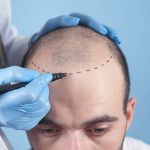
- Hairline marking
- Donor-area preparation
- Local anesthesia
- Graft harvesting
- Graft sorting and preservation
- Recipient-site creation
- Graft implantation
- Postoperative instructions
Hair transplantation is commonly performed as an outpatient procedure under local anesthesia, sometimes with sedation.
Is Hair Transplantation Painful?
Local anesthesia is used to reduce pain during the procedure.
Patients may still experience discomfort during:
- Anesthetic injections
- Early postoperative healing
- Donor-area tenderness
- Swelling
Pain experience varies between individuals.
No responsible clinic should guarantee a completely painless experience.
How Long Does Hair Transplantation Take?
The duration depends on:
- Number of grafts
- Extraction method
- Recipient area
- Surgical team
- Complexity
Large procedures may take much of the day.
NHS guidance also notes that very large treatment areas may require more than one session.
What Happens During the First Few Days?
Early postoperative symptoms can include:
- Swelling
- Tenderness
- Tightness
- Small scabs
- Mild discomfort
- Temporary numbness
Patients should follow the clinic’s specific washing and care instructions.
The grafts are particularly vulnerable during the early healing phase.
How Soon Can You Wash Your Hair?
Exact washing protocols vary by surgical team.
NHS guidance notes that patients may commonly begin gentle washing within the first week and should avoid disturbing the grafts during the early period.
Patients should follow the instructions provided by their own surgeon rather than relying only on general online timelines.
What Is Shock Loss?
After transplantation, the transplanted hair shafts often shed.
This can be alarming, but it is a common part of the hair-growth cycle.
The follicle remains beneath the skin and may later produce new hair.
Temporary shedding can also occur in some nearby native hairs.
When Does New Hair Start Growing?
Growth is gradual.
NHS guidance states that transplanted hairs often shed after a few weeks and new hair may begin appearing around several months later, with fuller results developing over many months.
Cleveland Clinic similarly notes that full results may take up to a year.
A realistic timeline may involve:
- Early weeks: healing and shedding
- Around 3–4 months: early new growth
- Around 6 months: more visible growth
- 9–12 months: increasing maturity
- 12–18 months: later-stage final appearance in some areas
The crown may mature more slowly than the frontal region.
Are Hair Transplant Results Immediate?
No.
A hair transplant is not an instant transformation.
Visible improvement develops gradually as new hair cycles into growth.
Patients should be cautious of claims promising immediate final density.
Can Transplanted Hair Fall Out?
The transplanted hair shafts commonly shed temporarily after surgery.
The follicles may then enter a new growth phase.
However, graft growth is not guaranteed in every case.
Cleveland Clinic lists poor graft growth as one of the possible complications of hair restoration surgery.
What Are the Risks of Hair Transplantation?
Hair transplantation is generally considered safe when performed appropriately, but it carries surgical risks.
Potential complications include:
- Bleeding
- Infection
- Swelling
- Scarring
- Temporary numbness
- Poor graft growth
- Unnatural appearance
- Anesthetic reaction
These risks are described in both NHS and Cleveland Clinic patient guidance.
Can Hair Transplantation Look Unnatural?
Yes, if planning or execution is poor.
Unnatural results may occur from:
- Straight hairlines
- Incorrect graft angles
- Excessive density in the wrong areas
- Poor donor management
- Large multi-hair grafts placed at the frontal edge
Natural-looking results depend heavily on design and placement.
Does FUE Leave Scars?
Yes.
FUE generally creates many small circular scars in the donor area.
They may be difficult to notice once healed, especially with some hair length, but FUE should not be marketed as completely scarless.
Can the Donor Area Be Overharvested?
Yes.
Removing too many follicles from a limited donor area can create visible thinning.
This is one reason graft number should not be treated as a competition.
More grafts are not automatically better.
The donor area needs to remain visually balanced after extraction.
How Many Grafts Are Needed?
The number depends on:
- Size of the recipient area
- Desired density
- Existing hair
- Hair shaft diameter
- Donor density
- Hair color and scalp contrast
A personalized assessment is needed.
Claims that every patient requires the same number of grafts are unreliable.
Hair Thickness and Coverage
Hair characteristics affect visual density.
Coverage can vary according to:
- Hair shaft thickness
- Curl
- Color
- Contrast with scalp
- Graft distribution
Two patients receiving the same number of grafts may achieve very different visual results.
Can Women Have Hair Transplantation?
Yes, but not every form of female hair loss is suitable.
Cleveland Clinic notes that many women with diffuse pattern thinning may lack a sufficiently stable donor area for transplantation.
A careful diagnosis is particularly important before recommending surgery.
Hair Transplantation for Beard or Eyebrows
Hair transplantation principles can also be used in selected cases involving:
- Beard areas
- Eyebrows
- Scar reconstruction
These applications require different hair angles and design considerations.
They should be performed by clinicians experienced in the specific area.
Hair Transplantation After Scarring
Some scars from:
- Injury
- Burns
- Previous surgery
may be suitable for transplantation.
However, scar tissue may have different blood supply and healing characteristics.
Cleveland Clinic notes that hair restoration may be used in selected cases involving hair loss from burns, injury, or scalp disease.
Hair Transplantation and Medical Treatment
Transplantation does not always replace medical hair-loss treatment.
Some patients may still benefit from therapies aimed at preserving non-transplanted hair.
The treating physician may discuss medical options depending on diagnosis, sex, age, and health history.
Medication should only be used under appropriate medical guidance.
Can Hair Loss Continue After Transplantation?
Yes.
Transplanted follicles may remain stable, but surrounding native hair can continue to thin.
This is why long-term planning matters.
A transplant that looks dense today may become unbalanced years later if future hair loss is ignored.
How Long Do Results Last?
Transplanted follicles taken from stable donor areas can provide long-lasting growth.
However, describing every result as guaranteed “for life” is too absolute.
Long-term appearance depends on:
- Donor stability
- Ongoing native hair loss
- Graft survival
- Age
- Medical factors
- Future treatment
Patients should be given realistic expectations.
Returning to Work
Return-to-work timing varies.
Cleveland Clinic notes that some patients may return to light activities within a few days, while NHS advises that some people may need one to two weeks away from work depending on recovery and appearance.
The best timing depends on:
- Job type
- Swelling
- Scabbing
- Procedure size
- Personal comfort
Exercise After Hair Transplantation
Strenuous exercise may need to be limited during early healing.
Heavy sweating, friction, and impact can affect the recovering scalp.
Patients should follow the clinic’s individual postoperative timeline.
When Should You Contact the Clinic?
Urgent assessment may be required if there is:
- Persistent fever
- Excessive bleeding
- Severe or worsening pain
- Significant redness
- Pus or other signs of infection
Cleveland Clinic specifically advises contacting the provider for persistent fever, excessive bleeding, severe redness or pain, or signs of infection.
Hair Transplantation in Istanbul
Istanbul is a major destination for international hair-restoration patients.
However, choosing treatment abroad should involve more than comparing graft numbers or package prices.
Patients should ask:
- Who performs the medical steps?
- What are the clinician’s qualifications?
- How is the donor area assessed?
- What technique is planned?
- How many grafts are appropriate?
- How is follow-up handled?
- What happens if complications develop?
- Who can be contacted after returning home?
Flash Cure Med provides hair transplantation services in Istanbul and currently discusses both FUE and DHI approaches within its hair-restoration content.
What to Look for in a Hair Transplant Clinic
Important factors include:
Medical Assessment
The clinic should first determine whether transplantation is appropriate.
Qualified Team
Patients should understand who will perform each part of the procedure.
Donor Planning
The donor area should be managed conservatively.
Natural Hairline Design
Hairline planning should reflect facial proportions and future hair loss.
Transparent Risk Discussion
Potential complications should be explained clearly.
Follow-Up
Patients need postoperative instructions and access to clinical support.
Questions to Ask Before Hair Transplantation
Before proceeding, ask:
- What is causing my hair loss?
- Am I a suitable candidate?
- Is my donor area strong enough?
- How many grafts are realistically available?
- Why is this technique recommended?
- Who performs the extraction?
- Who creates the recipient sites?
- Who implants the grafts?
- What scars should I expect?
- What are the main risks?
- What is the expected recovery timeline?
- How will future hair loss be managed?
- How is follow-up provided?
Clear answers support informed decision-making.
Frequently Asked Questions About Hair Transplantation
What is hair transplantation?
Hair transplantation is a surgical procedure that moves hair follicles from a donor area to areas affected by thinning or baldness.
What is FUE?
FUE is a harvesting technique in which individual follicular units are removed one by one from the donor area.
What is FUT?
FUT involves removing a strip of hair-bearing scalp and dividing it into individual grafts for transplantation.
Is hair transplantation permanent?
Transplanted follicles from stable donor areas may provide long-lasting growth, but future thinning of non-transplanted hair can still occur.
Does transplanted hair fall out first?
Temporary shedding of transplanted hair shafts is common before later regrowth begins.
When can I see new hair?
Early growth often becomes noticeable after several months, while fuller results can take around a year or longer.
Is FUE scar-free?
No. FUE leaves many small extraction scars, although they may become difficult to notice after healing.
Can women have hair transplantation?
Some women may be suitable, but diffuse hair loss can make donor availability limited. A medical assessment is required.
Can hair transplantation fail?
Yes. Poor graft growth, infection, scarring, or unsatisfactory appearance are possible complications.
Is DHI the same as FUE?
Not exactly. FUE mainly describes graft harvesting, while DHI generally refers to a particular implantation method.
Hair Transplantation Should Be Planned for the Long Term
Successful hair transplantation is not only about moving the highest possible number of grafts.
A responsible treatment plan should balance:
- Donor capacity
- Current hair loss
- Future hair loss
- Hairline design
- Graft distribution
- Natural growth angles
- Recovery
- Long-term follow-up
For the right candidate, hair transplantation can improve coverage in areas affected by permanent hair loss. But outcomes vary, and no clinic should guarantee identical density, completely scar-free healing, or perfect permanent results for every patient.
Flash Cure Med offers hair transplantation services in Istanbul and currently presents FUE and DHI within its hair-restoration treatment approach.
The safest starting point is a detailed assessment with qualified professionals who can evaluate the cause of hair loss, donor capacity, realistic graft numbers, surgical risks, and expected long-term appearance.
This article is intended for general informational purposes and does not replace individual medical assessment, diagnosis, or treatment advice.